 FDZ Games
2048
Slide the numbered tiles, merge matching pairs and keep doubling until you build the 2048 tile.
About 2048
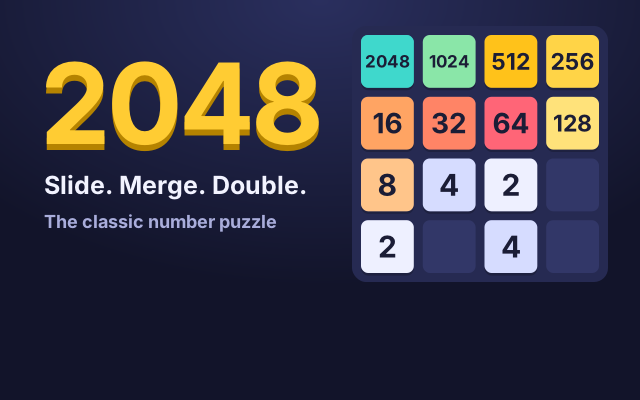
2048 is a sliding number puzzle played on a four-by-four grid. Every tile carries a power of two, starting with 2 and 4. When you push the board in one direction, every tile slides as far as it can go, and two tiles with the same number that run into each other fuse into a single tile worth their sum. Two 2s become a 4, two 4s become an 8, and so on up the chain. After each move a new 2 or 4 drops into a random empty square, so the board keeps filling up. Your goal is to keep merging until one tile reads 2048, without letting the grid jam solid.
The rules fit in one sentence, but the game rewards planning. Every merge frees a square, every move adds a tile, and you only ever control the direction of the slide, never an individual piece. A few careless swipes can scatter small numbers across the board and leave you with nothing to combine. A careful player, on the other hand, can keep the grid tidy for hundreds of moves, feeding a long chain of growing tiles toward one corner. That tension between quick, satisfying merges and the slow build of a single big tile is what has kept people playing since the game first appeared.
The original 2048 was written by the Italian developer Gabriele Cirulli and released for free on the web in March 2014. He built it over a weekend as a personal project, drawing on an earlier mobile game called 1024 and, further back, on Threes, a paid mobile puzzle by Asher Vollmer and Greg Wohlwend that introduced the idea of sliding and merging numbered cards. Cirulli published his source code openly, the game spread across social media within days, and it was soon copied into countless versions on phones, desktops and websites. Its simple design made it one of the best-known browser puzzles of the decade.
This version from FDZ Games keeps the classic rules exactly as most players know them. The board is four by four, new tiles are a 2 nine times out of ten and a 4 the rest of the time, and a tile that has just been created by a merge cannot merge again in the same move. Nothing about the odds is tuned against you: every new tile lands at random on one of the free squares. Your score goes up by the value of every tile you create, so making a 1024 adds 1024 points. When you reach 2048 you can stop and celebrate or choose Keep going and push for 4096, 8192 and beyond. The game ends only when the board is full and no two neighbouring tiles match.
Tiles glide across the grid and pop when they merge, and the game is built to feel quick on any device. On a computer you play with the arrow keys or W, A, S and D. On a phone or tablet you swipe anywhere on the screen, and the page stays put while you do, so you never scroll by accident. Your best score and the game you are in the middle of are saved in your browser on that device, so you can close the tab and pick up the same board later. There is nothing to download and no account to create.
Everyone slips sometimes, so each game comes with one free undo that takes back your last move. When ads are available you can watch a short optional video for more undos, and after a game over you can watch one to rewind the last three moves and try a different line. These extras are always your choice: the standard game is complete without them, and a run with no undos at all is the purest test of skill.
If you are new to 2048, start by watching where the new tiles appear and try to keep one row or column full so the board cannot shift under you. Experienced players usually pick a corner for their biggest tile and arrange the rest in a descending snake behind it. There is no timer and no pressure to hurry, so you can stop and think for as long as you need before each swipe. Whichever way you play, a round takes anything from a few minutes to half an hour, which makes it a good puzzle for a short break. Your best score is always on screen, so there is a clear target to beat the next time you sit down for a game.
- Genre
- Puzzle
- Released
- Platform
- Web browser (phone, tablet, desktop)
- Price
- Free
- Developer
- FDZ Labs Inc.
Features
- Classic 4×4 rules: 2s and 4s spawn, each tile merges once per move
- Smooth slide, merge and spawn animations on phone and desktop
- Swipe or use the arrow keys and WASD, with no page scrolling while you play
- One free undo per game, plus optional ad rewards for more undos or a continue
- Keep going past 2048; best score and the current board save automatically
How to play
- Swipe, or press an arrow key or W, A, S, D, to slide every tile on the board in that direction.
- Two tiles with the same number that collide merge into one tile worth their sum.
- After every move a new 2 or 4 appears in an empty square.
- Each merge adds the new tile's value to your score.
- Build a 2048 tile to win, then keep going for a higher score if you like.
- The game ends when the board is full and no neighbouring tiles match. Use Undo (U) to take back a move.
Controls
Desktop
- Arrow keys or W, A, S, D to slide the tiles
- U, Z or Ctrl/Cmd + Z to undo
- N for a new game
- M to mute or unmute
Phone and tablet
- Swipe up, down, left or right anywhere on the screen
- Tap Undo to take back your last move
- Tap New game to start over
Tips and strategy
- Pick one corner for your largest tile and keep it there for the whole game. Bottom-left or bottom-right works well for most players.
- Keep the row along that corner full, so a slide can never pull your big tile out of place.
- Build a descending chain from the corner, such as 512, 256, 128, 64, so each new merge rolls straight into the next.
- Use mostly two directions plus a third sparingly. If your corner is at the bottom, avoid pressing up unless there is no other move.
- Merge small tiles near the far side of the board early, before they get trapped between bigger numbers.
- Before each move, look at where the new tile can land. Moves that leave only one empty square in a safe spot are often the best ones.
- Save your free undo for a real mistake late in the game, when a stuck board would cost you the most.
Frequently asked questions
Is 2048 free to play?
Yes. It runs in your browser for free on phones, tablets and computers, with no download and no account.
Who created 2048?
The original was made by Gabriele Cirulli and released in March 2014. It was inspired by the earlier games 1024 and Threes. This is FDZ Games' own version of the classic rules.
What happens after I reach 2048?
You can start a new game or choose Keep going and carry on with the same board to chase 4096 and higher. Your score keeps counting.
How does the score work?
Every time two tiles merge, the value of the new tile is added to your score. Merging two 64s into a 128 adds 128 points.
Can I undo a move?
Each game has one free undo. When ads are available you can watch an optional short video for more undos, or to rewind the last three moves after a game over.
Is my game saved?
Yes. Your best score and the board you are playing are saved in your browser on this device, so you can close the page and continue later.